
Most arguments against free speech are contrived nonsense
We are being abused with sophistry.

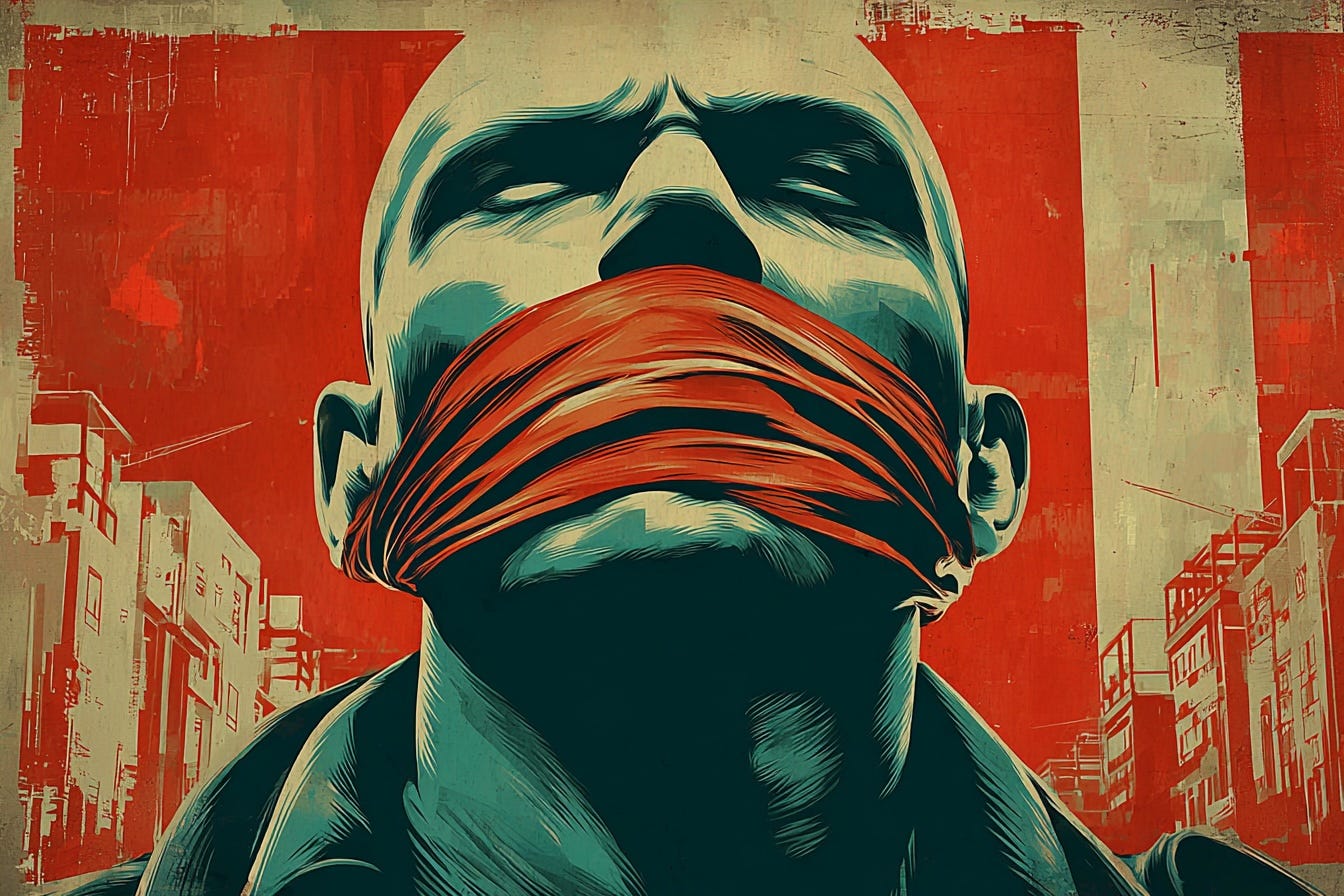
We live in an era where authorities have abandoned any pretence of supporting free speech.
Except for the USA where the First Amendment still carries weight, leading Western nations now openly censor and punish those who transgress imposed restrictions on speech.
My own country, Britain, seems to have fallen furthest despite its long history championing freedom of expression and exporting it to many places throughout the world.
We now rarely hear arguments in favour of unrestricted speech. The credentialed classes in leadership positions fear it too much. They use their intellectual talents to tarnish it with spurious notions of protecting the vulnerable from harm.
Most arguments against free speech are contrived nonsense. The truth is simpler. Free speech is easier, makes more sense and always works.
The basics
There are only two groups involved in discussions about censorship:
The Restriction Group wish to restrict some content; this means less content;
The Open Group wish to publish all content, including distasteful material.
The Open Group can guarantee everything gets a hearing, including criticism of objectionable, extreme or incorrect speech.
The Restriction Group, the censors, cannot guarantee everything will be published so we then need an additional debate as to what is allowed based on rules created by them.
With restriction, challenges to distasteful or incorrect content may be banned, meaning less effective speech overall. This cannot happen with a commitment to free speech.
The effect
Free speech is simpler. It has inbuilt correction, which also exploits freedom of speech. People are free to write content that challenges the distasteful or the untruthful. They bring more speech to correct offensive speech or wrong speech.
Restricted speech by comparison must be policed to ensure useful content is not accidentally banned. This is an additional overhead that doesn’t exist in free speech environments. Restricting speech is more complex to maintain.
Therefore:
Free speech requires no policing beyond what is explicitly banned on a given platform (see below);
Restricted speech requires considerable policing and judgment since some material is censored.
Policing speech is difficult
Restricted speech monitoring has an additional overhead. Someone must police the policing operation itself to ensure acceptable content is not inadvertently swept up in the bans.
This is not required by free speech as it is all permissible.
In addition, these arguments ignore the moral dimension. Who gets to decide what is restricted or not? Attempts to use democratic structures tend to fail as our democratic processes are routinely abused by the powerful. Even if possible, why should we accept the views of politicians? They are hardly exempt from bias.
The rational individual concludes that few people are ever in a position to decide for us all, so why bother when better methods exist?
Banning calls for grave harm
In many jurisdictions, especially the Anglosphere, some restrictions on speech have always existed. These tend to be calls for “grave harm”.
Harm can mean reputational harm or physical harm. You cannot falsely accuse someone of committing a crime (reputation) and nor can you threaten to maim or kill them (physical). By extension we normally restrict the ability to call for harm to entire groups (round up the Amish and eradicate them etc.).
Although the concept of grave harm can be a grey area, hence the need for courts, most platforms and their participants can spot most of it when they see it, just like pornography. The existence of some ambiguity in the notion of harm does not prevent us spotting blatant cases of calls to harm others.
Unlike more elaborate notions of restricted speech there is simply less nuance to the harm material. “You are a thief and a murderer”, “I’m going to kill the Amish”, and “you should kill the Amish too”, are all easy to spot as harmful. They involve obvious examples of harm to others.
By comparison, “trans women are biological males”, “women are irrational and shouldn’t be allowed to vote”, and “the people drafting climate policy seem to be mentally disturbed”, do not cause harm even if they offend because they are not calls to harm others even if some find them problematic.
Beware of sophistry
Most initiatives to control speech are based on emotive arguments. These often distort the accepted restrictions around notions of harm to further emotional arguments. They present non-harmful content as harmful.
They typically rely on sophistry, the deceptive use of clever but false arguments. Usually they disguise an emotional argument as a pseudo-legal one. Saying trans women are men causes emotional harm; it may invalidate the individual’s lived experience; in doing so we diminish them as people, as human beings; a lunatic will read this and end their lives. These things are dangerous and may cause harm, therefore they must be policed.
These are not harm. The statement is factually correct. Trans women are biological males. Facts may be difficult to absorb or accommodate for some, but they remain facts nonetheless. They may even be distasteful, upsetting or difficult to accept. But none of these are grounds for censorship.
Importantly, many statements labelled “hateful” or “harmful” are not calls to harm others even if people are offended or feel somehow attacked. Statements that offend are not harmful, they are offensive.
It is important to work at decoding sophistry. It is used to disguise calls to ban content some dislike. These are not reasonable grounds for restrictions. Therefore, they are unreasonable grounds for restrictions based upon a subjective point of view they wish others to accept uncritically. The antidote then is to not accept them.
Supporting free speech is not about taking sides
Arguments against free speech tend to focus on specific content. Hate, fascism, racism, sexism, climate denial. But true arguments in favour of freedom of expression avoid this trap. It is about being free to consume material and draw your own conclusions. The nature of the content is irrelevant.
Attempts to use emotive material to suggest it ought to be banned, and the support for free speech means you yourself support certain positions, are rhetorical manipulation. You can make the case to allow publication of unpopular or controversial ideas without being a proponent yourself.
Free speech is based on principle, not example. Everyone gets their say, anyone can read anything. The individual decides without an umpire deciding for them. It is nothing more than this.
That’s basically it. The rest is histrionics. Intolerant people who simply dislike alternative opinions and wish them to be unavailable.
The core argument is about freedom of expression not the content being presented. Society is healthier when a range of opinions are safe to publish, and when this plurality of views is available for the interested individual to make an informed choice or decision about a given topic.
When stated in this way counterarguments against giving people a greater range of unrestricted views tend to fall short. They become more obviously artificial which is why so much of the debate avoids the deep principle at stake and focuses instead on sentimental issues related to the content being presented as an attempt to short circuit our common sense.
However, the alternative to free speech is not better speech, protected speech or safe speech. The alternative to free speech is unfree speech. People are not at liberty to read or see material and come to their own conclusions. Someone else decides what can be consumed. Only slaves need this kind of supervision. The rest of us do fine on our own.
The first thing a kidnapper does is gag the victim so they cannot sound the alarm. Give up your free speech and the freedom of the press at your peril. Once they are able to silence you, the game is over. The loss of all of your other freedoms will fall like dominoes after. Anyone that advocates to censor you, or to unmask your anonymity is your adversary. Treat them like one - no matter what else they say.
But why is it so vital and necessary for the combined monolithic apparatus of government, corporations, and NGOs, to brute force censor everyone while decimating the careers and reputations of the dissenters? Here is why:
The reason the First Amendment is prime directive order 1, is because it is the most important freedom we have for the same reason it is the first target an adversary subverts, disrupts, and destroys during a crime, a war, or a takeover—preventing a target from assembling, communicating, and organizing a response to an assault grants an enormous advantage to the aggressors.
"If freedom of speech is taken away, then dumb and silent we will be led, like sheep to the slaughter." -Washington
And i am sorry to say it but this is where the rubber meets the road: The Second Amendment is second because it is the remedy for anyone trying to subvert the First.
‘The individual decides without an umpire deciding for them.’
This is the very heart of it. The people in charge, our elite, however you want to define that, cannot bear the idea that they do not get to be the umpires.
They demand the power to adjudicate over an increasing number of areas in our lives.
Speech is the most important of these areas of course, because curtailing our freedom of expression stops us complaining about their overreach.
Thanks Spiff great article. 👍